Contents
- 1 AI Marketing Expert vs Digital Marketing Agency in India
- 1.1 Table of Contents
- 1.2 Industry-Specific Guidance: Which Fits Your Business
- 1.3 Can You Use Both? The Hybrid Approach
- 1.4 Common Myths in This Comparison
- 1.5 What the First 90 Days Looks Like With Each Option
- 1.6 Red Flags Specific to Each Option
- 1.7 Illustrative Scenarios: Matching the Choice to the Business
- 1.8 How to Measure Whether You Made the Right Choice
- 1.9 What to Negotiate Before Signing, With Either Option
- 1.10 A Practical Checklist Before You Choose
- 1.11 India-Specific Considerations Worth Factoring In
- 1.12 How the Relationship Evolves Over Time
- 1.13 What Founders and Business Owners Say Matters Most in Hindsight
- 1.14 Let’s Connect
AI Marketing Expert vs Digital Marketing Agency in India
If you’re comparing an AI marketing expert vs a digital marketing agency in India, you’re likely close to making a hiring decision already. This isn’t a beginner question, it’s the question that comes right before signing a contract. I’m Jagadeeshwar, and I want to give you a direct, honest answer rather than a sales pitch for either side.
Table of Contents
- The Core Difference Between the Two
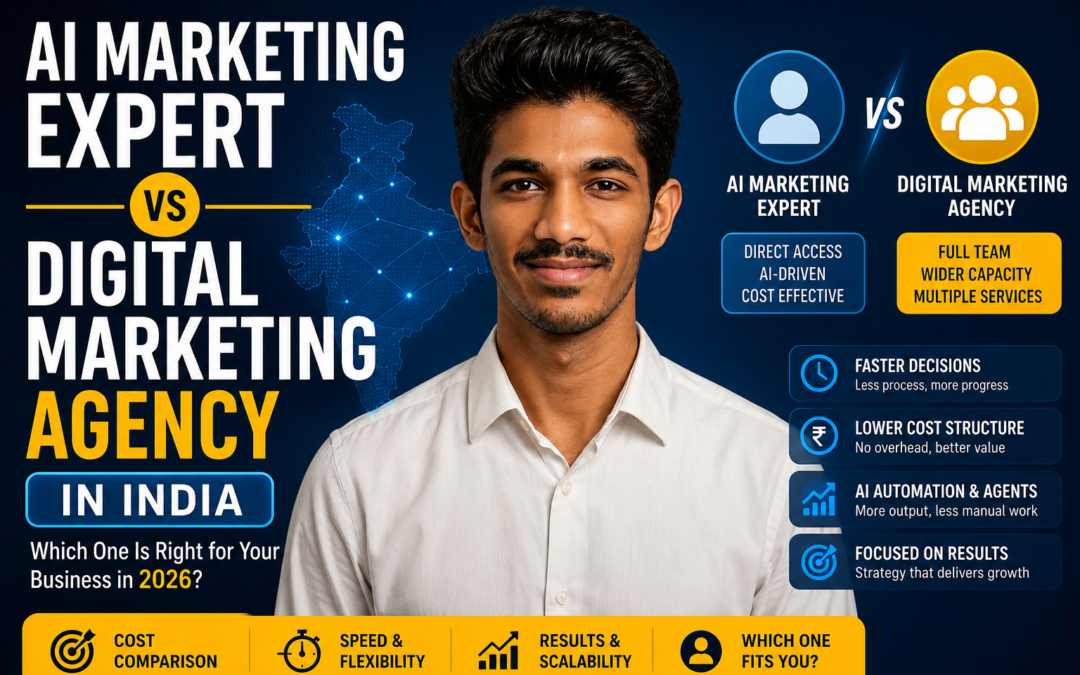
- AI Marketing Expert vs Digital Marketing Agency, Side-by-Side
- When an Agency Is Genuinely the Better Choice
- When an Independent AI Marketing Expert Is the Better Choice
- What Both Options Get Wrong If You’re Not Careful
- How to Decide for Your Specific Business
- Frequently Asked Questions
The Core Difference Between the Two
A digital marketing agency typically staffs your account with multiple specialists, a strategist, a designer, a paid ads manager, layered behind an account manager who coordinates them. An AI marketing expert, working independently, handles strategy and execution directly, often using AI automation and AI agents to cover ground that would otherwise require a larger team.
Neither structure is inherently better. They’re built for different situations, which is exactly why this comparison matters more than picking based on price or reputation alone.
This distinction has become sharper over the past two years specifically because of AI. A decade ago, an independent consultant genuinely couldn’t match an agency’s output volume, there simply weren’t enough hours in a day for one person to run multiple campaigns, produce consistent content, and manage customer engagement simultaneously. Automation and AI agents have changed that math. A single skilled person, using the right tools, can now cover ground that used to require three or four people. That shift is exactly why this comparison deserves a fresh look rather than assuming the old agency-always-wins logic still applies by default.
AI Marketing Expert vs Digital Marketing Agency, Side-by-Side
| Factor | AI Marketing Expert (Independent) | Digital Marketing Agency |
|---|---|---|
| Access | Direct, one point of contact | Filtered through account manager |
| Cost | Generally lower, no overhead layers | Higher, includes team and management costs |
| Speed | Faster decisions, fewer approvals | Slower, more internal process |
| Capacity | Limited to one person, extended by AI automation | Scales across a larger human team |
| Consistency | Same person throughout the relationship | Can shift if staff changes |
| Communication | Direct, no relay | Passed through account manager |
| Setup time | Often faster to start | Can involve longer onboarding |
| Best fit | Startups, solo founders, lean teams | Larger businesses needing broad, simultaneous coverage |
A Deeper Look at Cost Differences
Cost is usually the first thing people compare, but the real difference isn’t just the headline number, it’s what that number is actually paying for.
Agency pricing bakes in overhead you may not need, A significant share of an agency retainer covers account management, internal coordination between specialists, and business overhead that has nothing to do with the actual marketing work being done for you. This isn’t wasteful for a business that genuinely needs that coordination across many channels, but it’s pure cost for a business that doesn’t.
Independent AI marketing expert pricing reflects leaner delivery, Without an account management layer and with AI automation handling repetitive execution work, the cost structure is fundamentally different, not just discounted, but built around a different delivery model entirely.
The real cost comparison should be per-outcome, not per-hour A cheaper option that delivers weaker results isn’t actually cheaper. Compare based on what each option can realistically deliver for your specific situation, not just the sticker price.
When an Agency Is Genuinely the Better Choice
You need many channels running simultaneously, If your business needs paid ads, SEO, content, and design all moving at once at real volume, an agency’s team structure genuinely outperforms what one person can cover alone, even with strong automation support.
You have the budget to support it, Agency retainers reflect the cost of a full team. If your budget comfortably supports that, you get real redundancy and broader coverage in return, without needing to worry about a single point of failure.
You want built-in backup, If a single point of contact leaving would seriously disrupt your marketing, an agency’s team structure protects against that risk in a way independent consulting structurally cannot.
Your business has complex, multi-stakeholder marketing needs, Larger organizations with multiple internal teams needing coordination, brand, sales, product, often benefit from an agency’s experience managing that kind of internal complexity.
When an Independent AI Marketing Expert Is the Better Choice
You’re a startup or solo founder without agency-level budget, This is where an AI marketing expert consistently delivers more value per rupee spent, since automation replaces much of what would otherwise require additional agency headcount.
You want direct access to the person doing the work, No account manager layer, no relayed updates, no information getting slightly altered as it passes between people. What I do for a client, I explain to them directly, and I hear directly what’s actually working or not working for their business.
Your biggest need is an integrated system, not scattered services, Automation, AI agents, SEO, and content working together as one connected system is exactly the kind of focused, hands-on build an independent AI marketing expert is built to deliver, rather than several disconnected specialists each optimizing their own slice without a unified view.
You need to move fast, Fewer approval layers means changes and decisions happen in days, not weeks. For an early-stage business where speed genuinely matters to survival, this isn’t a minor convenience, it’s often the difference between capturing an opportunity and missing it.
You value continuity over redundancy, Working with the same person throughout means they build genuine, accumulated understanding of your business over time, rather than staff turnover resetting that context periodically.
Industry-Specific Guidance: Which Fits Your Business
E-commerce and D2C brands at an early stage typically benefit from an independent AI marketing expert who can build integrated automation for cart recovery, personalization, and customer engagement quickly. Larger, established e-commerce brands running significant simultaneous ad spend across multiple platforms often shift toward agency support as complexity grows.
Real estate businesses and agents frequently do well with an independent expert managing AI-driven lead qualification and follow-up, since this is a focused, high-impact need that doesn’t require broad multi-channel complexity.
B2B and professional services firms often start with an independent expert for SEO, content, and lead automation, then consider agency support only once they’re running significant simultaneous paid campaigns across multiple channels.
SaaS and technology startups typically benefit most from an independent AI marketing expert during early growth, given the need for a tightly integrated system connecting content, SEO, and automated onboarding, then may add agency support for large-scale paid acquisition once product-market fit is established.
Larger, established enterprises with dedicated internal marketing teams often use agencies as an extension of that team for specific, bounded projects, rather than choosing between the two options exclusively.
Can You Use Both? The Hybrid Approach
This comparison doesn’t have to be all-or-nothing. A growing number of businesses use a hybrid model: an independent AI marketing expert managing the core, integrated system, automation, AI agents, SEO, and content strategy, while bringing in an agency or specialist freelancer for a specific, bounded need like a large seasonal ad campaign or a rebrand project.
This works well specifically because the core, ongoing system benefits from consistency and integration, which an independent expert delivers naturally, while occasional, bounded projects benefit from the extra capacity an agency or specialist can provide temporarily without disrupting the core relationship.
The key to making this work is clarity about which party owns what. Confusion about overlapping responsibilities between an independent expert and an agency working simultaneously is one of the most common reasons hybrid arrangements underperform, so this needs to be explicitly defined from the start, not left ambiguous.
What Both Options Get Wrong If You’re Not Careful
Agencies can spread junior staff across too many clients, meaning your account gets less senior attention than the pitch implied. Ask directly who will actually handle your work day to day, not just who signed the contract.
Independent experts can overpromise capacity, One person genuinely cannot do everything a large agency can. A good AI marketing expert is upfront about this and uses automation deliberately to extend capacity, not to paper over real limitations they’re hoping you won’t notice.
Both can hide behind vague AI claims, AI-powered means little without specifics. Whichever you choose, ask for concrete examples: what’s automated, what an AI agent actually does, and what results that’s produced for comparable clients.
Both can lock you into long contracts before proving fit, Regardless of which option you choose, starting with a smaller, clearly scoped project before committing to a long-term retainer protects you from a poor fit becoming an expensive, drawn-out mistake.
Common Myths in This Comparison
Agencies are always more professional and reliable, Professionalism and reliability depend on the specific people and processes involved, not the business structure. Plenty of independent experts run highly professional, well-documented engagements, and plenty of agencies deliver inconsistent work behind a polished pitch.
An independent expert can’t handle a growing business, With the right automation and AI agent infrastructure in place, independent experts can scale their impact significantly beyond what their individual hours alone would suggest, though there is a real ceiling eventually if complexity grows enough.
Agencies always cost more for the same result, This is often true but not universal. Some agencies structure lean, efficient teams that deliver strong value; some independent experts price at a premium reflecting deep specialization. Compare actual proposals, not category stereotypes.
You should pick based on which one has better testimonials, Testimonials matter, but fit matters more. A glowing testimonial from a business very different from yours in size, industry, or need tells you less than a mediocre-sounding review from a business that closely resembles your own situation.
What the First 90 Days Looks Like With Each Option
Understanding the actual onboarding experience helps set realistic expectations, since this differs meaningfully between the two paths.
With an agency, the first 90 days typically involve a formal onboarding process: discovery calls with multiple stakeholders, a written strategy document, internal handoffs between the account manager and specialist teams, and a structured kickoff timeline. This process exists for good reason, coordinating a larger team requires more formal documentation, but it also means more time passes before execution actually begins. Many businesses report that meaningful campaign work doesn’t start until three to six weeks into an agency engagement, once internal alignment is complete.
With an independent AI marketing expert, the first 90 days tend to move faster and more informally. A shorter discovery conversation, direct agreement on priorities, and execution beginning within days rather than weeks is the norm, since there’s no internal team to align first. The tradeoff is that documentation and formal process are typically lighter, which works well for businesses that value speed over ceremony, but may feel less structured to a business used to enterprise-style engagements.
Neither approach is objectively better during this period. A business that values thorough upfront planning may prefer the agency’s structured process. A business that needs to see results and iterate quickly may find the independent expert’s faster start more valuable, even if it comes with less formal documentation along the way.
Red Flags Specific to Each Option
Beyond the general warning signs already covered, a few red flags are worth watching for specifically depending on which path you’re considering.
Agency-specific red flags: A pitch team that’s noticeably more senior and engaged than the team you’ll actually work with day to day. Vague answers about which specific person handles your account. Reluctance to specify how many other clients your assigned team members are simultaneously managing. A contract structure that locks you in for twelve months with no early exit or trial period option.
Independent expert-specific red flags: No clear plan for what happens if they’re unavailable due to illness or other circumstances. Overpromising on turnaround times that don’t account for the realistic limits of one person’s bandwidth, even with automation support. Reluctance to provide any client references, even anonymized ones. No structured process for reporting and check-ins, leaving you unsure how things are actually progressing between conversations.
Both categories of red flags come down to the same underlying issue: a gap between what’s promised during the sales conversation and what’s realistically deliverable once the engagement begins. Asking direct, specific questions about day-to-day execution before signing anything is the most reliable way to surface this gap early, regardless of which option you’re evaluating.
Illustrative Scenarios: Matching the Choice to the Business
Concrete examples make this comparison easier to apply to your own situation. These are illustrative patterns, not claims about specific named businesses.
A two-person e-commerce startup with a modest marketing budget, With limited budget and a need for an integrated system covering automation, content, and basic paid ads, an independent AI marketing expert is typically the more practical choice, delivering focused, hands-on support without the overhead an agency retainer would require relative to the available budget.
An established manufacturing company launching a new product line across five regional markets simultaneously, This scenario involves genuine multi-channel complexity, coordinated regional campaigns, larger content volume, and multiple simultaneous paid initiatives, that benefits from an agency’s team structure and existing process for managing this kind of coordinated complexity.
A solo consultant building a personal brand and needing consistent content plus lead automation, This is close to an ideal fit for an independent AI marketing expert, since the need is focused, integrated, and doesn’t require the broad channel coverage an agency team is built for.
A mid-sized SaaS company with an internal marketing team needing extra capacity for a single major product launch, Rather than choosing exclusively between the two, this scenario often calls for the hybrid approach discussed earlier: the internal team and an independent expert handling ongoing work, with a specialist agency brought in temporarily for the launch-specific push.
A real estate agency handling high inquiry volume but struggling with qualification and follow-up consistency, This narrow, high-impact need, automated lead qualification and consistent follow-up, is well-suited to an independent AI marketing expert building a focused automation and AI agent system, without requiring the broader service coverage an agency would bundle in unnecessarily.
How to Measure Whether You Made the Right Choice
Regardless of which option you choose, measuring the decision honestly after a few months prevents sunk-cost thinking from keeping you in a poor fit longer than necessary.
Track response time and lead conversion from day one, These are among the fastest metrics to show whether either option is delivering real operational improvement, typically visible within the first month.
Evaluate communication quality after the initial excitement fades, The first few weeks of any new engagement tend to involve more attentive communication than what becomes the steady-state pattern. Judge the relationship on months two and three, not just the honeymoon period.
Compare actual deliverables against what was promised during the sales conversation, A gap here, work that consistently falls short of what was pitched, is one of the clearest signals of a poor fit, regardless of whether you chose an agency or an independent expert.
Reassess at a natural checkpoint, not just when something goes wrong, Building in a planned 90-day review, regardless of how things feel in the moment, creates space for an honest, structured conversation about whether the current arrangement is genuinely working, rather than only revisiting the decision reactively once problems have already accumulated.
What to Negotiate Before Signing, With Either Option
Regardless of which path you choose, a few contract terms are worth negotiating upfront rather than accepting the first draft presented to you.
A trial period or smaller initial scope before a long-term commitment, Both agencies and independent experts should be willing to prove fit on a smaller, clearly bounded project before you commit to a six or twelve month retainer. Resistance to this is itself useful information about how confident they are in their own ability to deliver.
Clear, specific deliverables tied to your primary goal, not vague activity descriptions, A contract promising “ongoing marketing support” tells you little. A contract specifying exactly what will be built, delivered, or improved, and by when, gives you something concrete to hold the engagement accountable to.
A defined reporting cadence and format agreed in writing, Whether monthly, biweekly, or weekly, agree on how often you’ll receive updates and what those updates will actually contain, tied to business outcomes rather than just activity summaries.
An exit clause that doesn’t trap you in a poor fit, Whether it’s a 30-day notice period or a defined off-ramp after the initial term, make sure you’re not locked into a long-term commitment with no reasonable way out if the engagement isn’t working.
Clarity on who owns what once the engagement ends, If the relationship ends, do you retain access to automation workflows, AI agent configurations, and accounts built during the engagement? This should be explicit in writing before you start, not negotiated after a difficult parting.
A Practical Checklist Before You Choose
Use this checklist alongside everything covered above to make a final, confident decision.
Business needs assessment:
- Have I clearly identified whether I need broad, multi-channel coverage or a focused, integrated system?
- Have I documented my realistic budget range, including what agency overhead would actually cost versus what an independent expert would charge for comparable outcomes?
- Have I considered how much I personally value direct access versus the redundancy of a larger team?
Vetting the specific provider, whichever type:
- Have I asked for specific, verifiable results from comparable client work, not just general claims?
- Do I know exactly who will handle my account or engagement day to day?
- Have I confirmed what happens after the initial setup or campaign launch, in terms of ongoing monitoring and adjustment?
- Have I gotten a trial period or smaller initial scope agreed before committing to a longer retainer?
Contract and terms:
- Are deliverables specific and tied to my actual goals, not vague activity descriptions?
- Is a reporting cadence and format agreed in writing?
- Do I have a reasonable exit option if the engagement isn’t working?
- Is ownership of any built systems, automation, AI agents, accounts, clear if the relationship ends?
Working through this checklist before signing anything, with either an agency or an independent AI marketing expert, consistently produces better outcomes than making the decision primarily on reputation or a compelling sales conversation alone.
India-Specific Considerations Worth Factoring In
A few dynamics specific to the Indian market are worth layering onto everything covered above, since global generic advice on this comparison doesn’t always translate directly.
The freelance and independent consulting ecosystem in India has matured significantly, What used to be a market where independent marketing consultants were seen as a budget compromise has shifted, with skilled independent AI marketing experts increasingly viewed as a legitimate, sometimes preferred, alternative to agency engagements, particularly among startups and digitally native businesses.
Regional language and market nuance can favor either option depending on execution, A large national or multi-city agency may have broader exposure to different regional markets across India, which can be valuable for a business expanding into new geographies. An independent expert with deep, specific experience in your particular target market or industry vertical may offer more relevant, focused expertise than a generalist agency team, even without that broader geographic exposure.
Cost expectations in India create more room for independent experts to compete on value, Given the overall cost structure of the Indian services market, the price gap between agency retainers and independent expert engagements can be substantial, making the independent option particularly attractive for cost-conscious startups without necessarily sacrificing quality, provided proper vetting has been done.
Client expectations around communication speed tend to run high in the Indian startup ecosystem specifically, Founders accustomed to fast-moving, WhatsApp-driven communication culture often find an independent expert’s typically faster response times a better cultural fit than a more formally structured agency communication process, though this varies by individual provider on both sides.
AI adoption maturity varies significantly by city and sector within India, A provider, agency or independent, based in or with deep experience in a specific city or industry hub may bring genuinely more relevant, current expertise than one operating more generically, which is worth weighing alongside the broader agency-versus-independent decision covered throughout this guide.
None of these factors should override the core decision framework covered earlier in this guide, but they’re worth keeping in mind as you evaluate specific options within the Indian market context rather than applying purely generic, geography-agnostic advice.
How to Decide for Your Specific Business
Ask yourself three questions honestly:
- Do I need broad, simultaneous coverage across many channels, or a focused, integrated system? Broad → agency. Focused and integrated → independent expert.
- What’s my realistic budget, and does it comfortably support agency overhead? If not, an independent AI marketing expert delivers more for the same spend.
- How important is direct, consistent access to the person doing the work? If this matters a lot, independent expertise wins clearly.
A fourth, less obvious question is worth adding: how much internal marketing capability do I already have? A business with some existing internal marketing knowledge can work effectively with either option, since they can evaluate and guide the work themselves. A business with little internal marketing background may benefit more from an independent expert who explains things directly and builds genuine understanding over time, rather than an agency relationship that can feel more like a black box.
If you want to see exactly how an integrated, AI-driven approach works for a business like yours, read the full breakdown: Best AI Marketing Expert in India.
How the Relationship Evolves Over Time
A comparison like this often gets framed as a single, permanent decision, but in practice, the right choice at month one isn’t always the right choice at month eighteen, and understanding how each relationship tends to evolve helps you plan rather than react.
With an agency, the relationship typically becomes more efficient over time as the team builds institutional knowledge of your business, provided staff turnover doesn’t reset that progress. Many businesses report that agency relationships take several months to reach full stride, since the team needs time to internalize brand voice, audience nuances, and internal processes before execution becomes truly seamless.
With an independent AI marketing expert, the relationship often becomes more valuable faster, since one person accumulating deep context happens more quickly than a team collectively absorbing it. The tradeoff emerges later: as a business scales significantly, the question becomes whether continued automation investment can keep pace with growing complexity, or whether a point arrives where additional human capacity becomes genuinely necessary.
Neither path is static. Businesses that started with an independent expert sometimes add agency support for a specific expanded need without ending the original relationship. Businesses that started with an agency sometimes bring on an independent AI marketing expert specifically to manage automation and AI agent systems that the agency’s broader team structure isn’t optimized to build. Planning for this evolution from the start, rather than assuming your initial choice is permanent, leads to better long-term decisions.
What Founders and Business Owners Say Matters Most in Hindsight
Drawing on common patterns in how businesses describe their experience after working with both types of providers, a few themes come up repeatedly, regardless of which option they ultimately chose.
Responsiveness matters more than most people expect going in, Businesses consistently rate how quickly and clearly a provider communicates, agency or independent expert, as more important in hindsight than the specific tools or platforms used. A brilliant strategy poorly communicated creates more frustration than a solid strategy clearly explained.
Understanding the “why” behind recommendations builds more trust than the recommendations themselves, Businesses that felt genuinely informed about why a specific automation, campaign, or content approach was chosen reported significantly higher satisfaction than those who simply received deliverables without context, regardless of which type of provider they worked with.
The vetting process itself often predicts the relationship quality, Businesses that skipped thorough vetting in favor of a fast decision, based on a compelling pitch or recommendation alone, report mismatched expectations more frequently than those who took the time to ask the specific questions covered throughout this guide before committing.
Cost satisfaction depends more on perceived value than the absolute number, A relatively expensive agency retainer delivering clear, attributable results generates more satisfaction than a cheaper independent engagement with vague reporting, and the reverse holds equally true. The lesson isn’t that one option is more cost-effective in the abstract, it’s that clear reporting tied to real outcomes drives perceived value regardless of the specific price point.
These patterns reinforce the core message of this entire comparison: the structural difference between an agency and an independent AI marketing expert matters less than the specific fit, communication quality, and follow-through of whichever option you choose.
Frequently Asked Questions
Is an AI marketing expert cheaper than a digital marketing agency in India?
Generally yes, since there’s no account management overhead built into the pricing. The gap narrows if you need broad, multi-channel coverage that a single person can’t realistically deliver.
Can one AI marketing expert really replace a full agency team?
For a focused, integrated system, automation, AI agents, SEO, and content working together, often yes, particularly for startups and small businesses. For businesses needing simultaneous coverage across many unrelated channels, an agency’s team capacity may still be necessary.
What should I ask before choosing between the two?
Ask for specific, verifiable results, ask exactly who will handle your work day to day, and ask what happens after the initial setup, since ongoing monitoring matters more than the initial pitch either way.
Is it common for businesses to switch from an agency to an independent expert, or the other way around?
Yes, both directions happen regularly, usually driven by a mismatch between the business’s actual needs and the provider’s structure, rather than dissatisfaction with quality alone. A business that outgrows an independent expert’s capacity, or one that finds an agency’s overhead no longer justified, will typically switch.
Should a very early-stage startup with almost no budget choose either option?
Often the most practical starting point for a pre-revenue startup is a very narrowly scoped project with an independent expert, or even self-managed tools, before committing to either a full agency retainer or an ongoing independent engagement, until there’s enough traction to justify the investment either way.
How do I know if an agency or independent expert is exaggerating their AI capabilities?
Ask for a specific, plain-language walkthrough of exactly what’s automated and how, along with real examples from comparable client work. Vague references to “AI-powered” strategies without specifics are a reasonable signal to ask more pointed follow-up questions before committing.
Does company size determine which option I should choose, or is it more about specific needs?
It’s more about specific needs than raw company size, though the two are often correlated. A large company with a narrow, focused marketing need might still be well-served by an independent expert, while a small company with unusually complex, multi-channel requirements might genuinely need agency-level support despite its size.
What happens if I choose an independent expert and my business grows faster than expected?
A well-run independent engagement should be able to scale meaningfully using additional automation and AI agent capacity before hitting a hard ceiling. If growth eventually exceeds what one person can reasonably manage even with strong automation, transitioning to a hybrid model or bringing in additional support becomes the natural next step, rather than requiring an abrupt full switch to an agency.
Are there hidden costs I should watch for with either option?
With agencies, watch for costs outside the core retainer, ad spend management fees, tool licensing passed through to you, or charges for work classified as “outside standard scope.” With independent experts, watch for unclear boundaries around what’s included in automation setup versus ongoing maintenance, which can otherwise become a source of scope creep and unexpected additional charges.
How long should a trial engagement last before deciding on a longer commitment?
A trial period of four to eight weeks is usually enough to evaluate communication quality, initial deliverables, and whether the working relationship feels right, without committing to a full quarter or year before you have real evidence of fit.
Can I negotiate a lower price with either option, and is that a red flag if they agree too easily?
Negotiation is normal and reasonable with both options, particularly for project-based work. If a price drops dramatically with very little pushback, it’s worth asking directly what’s being adjusted, scope, hours, or deliverables, to understand what you’re actually trading for the lower cost.
Is there a meaningful difference in contract flexibility between agencies and independent experts?
Independent experts are often more flexible on contract terms, since they’re not operating within a larger organization’s standardized process. Agencies may have more rigid, templated contracts, though this varies significantly by agency size and how established their internal processes are.
Let’s Connect
I’m Jagadeeshwar, and if you’re weighing this decision for your own business, I’m happy to talk it through directly.
Website: jagadeeshwar.com
LinkedIn: Connect
Instagram: Connect
X : Connect
.